
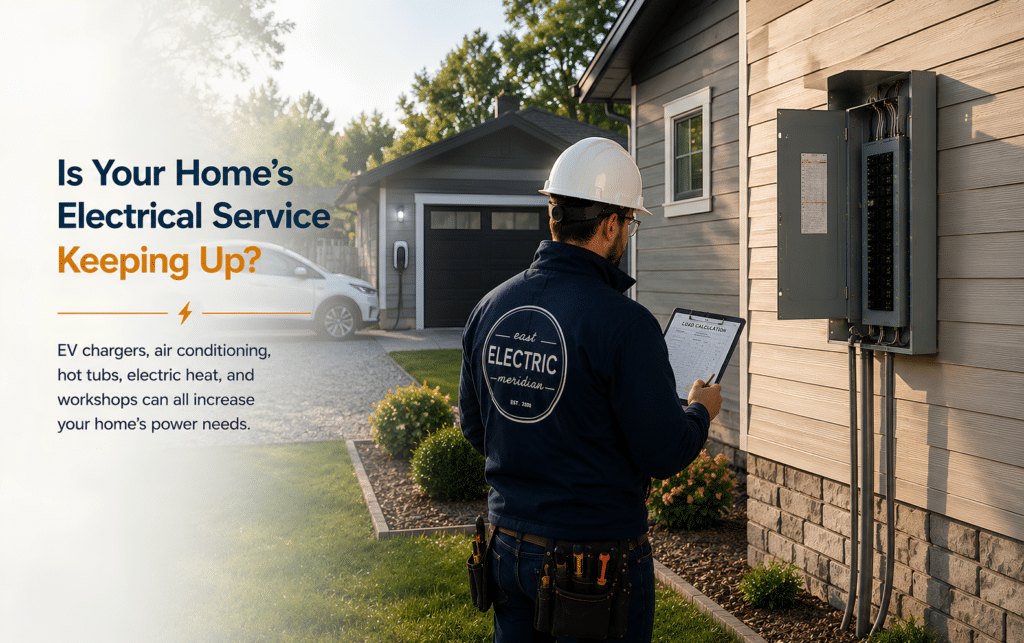
A new EV charger. Central air conditioning. A hot tub. Electric heat. A workshop full of tools.
Modern homes can use electricity very differently than they did when their electrical systems were originally installed.
At East Meridian Electric, one question we hear from homeowners is whether a 100-amp service is still enough or whether moving to 200 amps makes sense.
The answer isn’t automatically 200A. The right electrical service size depends on what your home already uses, what you’re planning to add, and how those electrical loads operate together.
For homeowners in the RM of Macdonald, understanding that difference can help you make better decisions before a renovation, major equipment purchase, or electrical upgrade.
What Does 100A or 200A Actually Mean?
The amperage of your electrical service refers to how much electrical current the service is designed to supply.
Manitoba Hydro identifies 100A and 200A at 120/240 volts as typical residential service sizes.
A 100A service may be perfectly adequate for some homes. Another property with electric heating, an EV charger, a hot tub, and a large workshop may have significantly greater electrical requirements.
That’s why we don’t recommend choosing an electrical service size based only on what is common in newer homes.
We look at the actual electrical demand.
When Can a 100A Service Be Enough?
A 100A service isn’t automatically outdated or inadequate.
It may continue to serve a home effectively when electrical demand is relatively modest.
For example, a home may have:
- Natural gas heating
- Natural gas water heating
- Standard kitchen appliances
- No EV charger
- No hot tub
- Limited workshop equipment
- Few major electrical additions planned
The condition of the existing equipment also matters.
If the service and panel are in good condition and the calculated electrical load remains within their capacity, an upgrade may not be necessary simply because 200A is available.
When Does 200A Become Worth Considering?
The conversation changes when a homeowner starts adding larger electrical loads.
We often recommend evaluating available capacity when you’re considering:
- An EV charger
- Electric heating
- Central air conditioning or a heat pump
- A hot tub
- An electric range or additional kitchen equipment
- A home addition
- A secondary suite
- A detached workshop
- Large power tools
- Future electrification projects
One addition alone doesn’t necessarily mean you need 200A.
But several new loads can change the overall demand enough that the existing electrical service size should be assessed before installation begins.
Your Electrical Panel Isn’t the Whole Story
It’s easy to look at a panel, see a few empty breaker spaces, and assume there is room for more equipment.
Electrical capacity doesn’t work that way.
Available breaker spaces tell us whether there is physical room for additional breakers. They don’t tell us whether the electrical service has enough capacity to support the additional load.
When we evaluate a home, we may consider:
- Existing service rating
- Heating type
- Major appliances
- Current electrical loads
- New equipment being planned
- Existing panel condition
- Future additions
This gives us a much better picture than simply counting empty spaces in the panel.
Renovations Can Change the Equation Too
A renovation can quietly add more electrical demand than homeowners expect.
A kitchen renovation may introduce new appliances. A basement development creates additional lighting and receptacle loads. A home addition may include heating, cooling, or other equipment.
Even if each individual change seems manageable, the combined electrical demand should be considered.
This is why we prefer to review electrical capacity during the planning stage not after construction is already underway.
Think About the Next Five to Ten Years
When we’re evaluating an electrical system, we don’t only ask what the homeowner needs today.
We also ask what’s coming next.
Maybe you don’t own an EV yet, but your next vehicle could be electric. Maybe the detached garage will eventually become a heated workshop. Maybe a hot tub or home addition is part of the long-term plan.
Thinking ahead doesn’t mean automatically installing the largest service possible.
It means choosing an electrical service size that makes sense for how you expect the property to evolve.
How Do We Determine What Your Home Needs?
The decision between 100A and 200A should be based on electrical demand rather than guesswork.
When changes or upgrades to residential electrical service are requested, Manitoba Hydro requires electrical information that includes estimated demand and the total added load.
For us, that reinforces the right way to approach the question: evaluate the home and its electrical loads first.
We consider the existing system, planned equipment, heating, appliances, and future requirements before recommending whether an upgrade makes sense.
What Is Involved in a Service Upgrade?
A service upgrade is more involved than simply replacing a breaker.
Depending on the existing installation, the project may involve changes to the:
- Electrical panel
- Main service equipment
- Metering equipment
- Service conductors
- Grounding and bonding
- Utility connection
Because this work involves the consumer’s electrical service, Manitoba Hydro requires it to be completed by a licensed electrician.
Applicable electrical permits must also be obtained before work begins, and the completed electrical work must be inspected for compliance with the Manitoba Electrical Code.
At East Meridian Electric, we coordinate the electrical side of the project so these requirements are incorporated into the upgrade process.
Do You Actually Need 200A?
Maybe, but don’t make the decision based on the number alone.
Some homes can continue operating reliably with 100A. Others have reached the point where additional equipment and future plans make 200A a more practical option.
The right answer comes from understanding your home’s actual electrical demand.
At East Meridian Electric, we can assess your existing panel and electrical service size, review what you’re planning to add, and determine whether your current system has enough capacity.
Plan for the Home You’re Building Toward
Your electrical system should support more than the way your home worked ten years ago. It should also be ready for the way you plan to use it next.
If you’re considering an EV charger, renovation, hot tub, electric heating, workshop, or another major electrical addition in the RM of Macdonald, talk to East Meridian Electric before assuming you need or don’t need a service upgrade.
We’ll assess your current electrical service size, review your planned electrical loads, and help determine whether 100A remains appropriate or whether moving to 200A makes sense for your home.
